|
Gay Wisdom for Daily Living brought to you by White Crane Institute ͏ ͏ ͏ ͏ ͏ ͏ ͏ ͏ ͏ ͏ ͏ ͏ ͏ ͏ ͏ ͏ ͏ ͏ ͏ ͏ ͏ ͏ ͏ ͏ ͏ ͏ ͏ ͏ ͏ ͏ ͏ ͏ ͏ ͏ ͏ ͏ ͏ ͏ ͏ ͏ ͏ ͏ ͏ ͏ ͏ ͏ ͏ ͏ ͏ ͏ ͏ ͏ ͏ ͏ ͏ ͏ ͏ ͏ ͏ ͏ ͏ ͏ ͏ ͏ ͏ ͏ ͏ ͏ ͏ ͏ ͏ ͏ ͏ ͏ ͏ ͏ ͏ ͏ ͏ ͏ ͏ ͏ ͏ ͏ ͏ ͏ ͏ ͏ ͏ ͏ ͏ ͏ ͏ ͏ ͏ ͏ ͏ ͏ ͏ ͏ ͏ ͏ ͏ ͏ ͏ ͏ ͏ ͏ ͏ ͏ ͏ ͏ ͏ ͏ ͏ ͏ ͏ ͏ ͏ ͏ ͏ ͏ ͏ ͏ ͏ ͏ ͏ ͏ ͏ ͏ ͏ ͏ ͏
|
|
||||
| This Day in Gay History | ||||
February 23Born 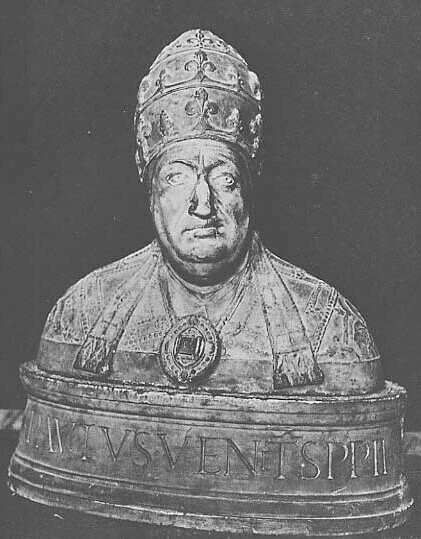 Pope Paul II Pope Paul II1417 - POPE PAUL II, born (d: 1471); Exceptionally vain (even for a pope) – Paul wanted to take the name “Formosus I,” i.e. "the Well-Shaped, " upon his erection, er, I mean election. Any name chosen would have been better than the one given him sarcastically by his successor, Pius II – “Maria Pietissima,” – Our Lady of Pity. All of this is delicious rumor, of course, as is the story of his death of a heart attack while playing bottom to his favorite top. Popes have a lot of enemies, you know. Most of them well-earned. 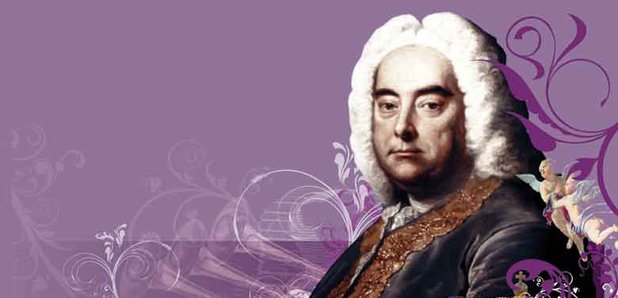 Georg Friedrich Handel Georg Friedrich Handel1685 - GEORG FRIEDRICH HANDEL, German/British Baroque composer born (d. 1759); “Handle”...it’s correctly pronounced “handle” a friend used to cajole. Of the German composer who anglicized the spelling of his name upon removing to England, a contemporary wrote: “His social affectations were not very strong; and to this it may be imputed that he spent his whole life in a state of celibacy; that he had no female attachments of another kind may be ascribed to a better reason.” What was the “better reason” that made Handel eschew not only marriage, but “female attachments of another kind,” presumably mistresses or whores? 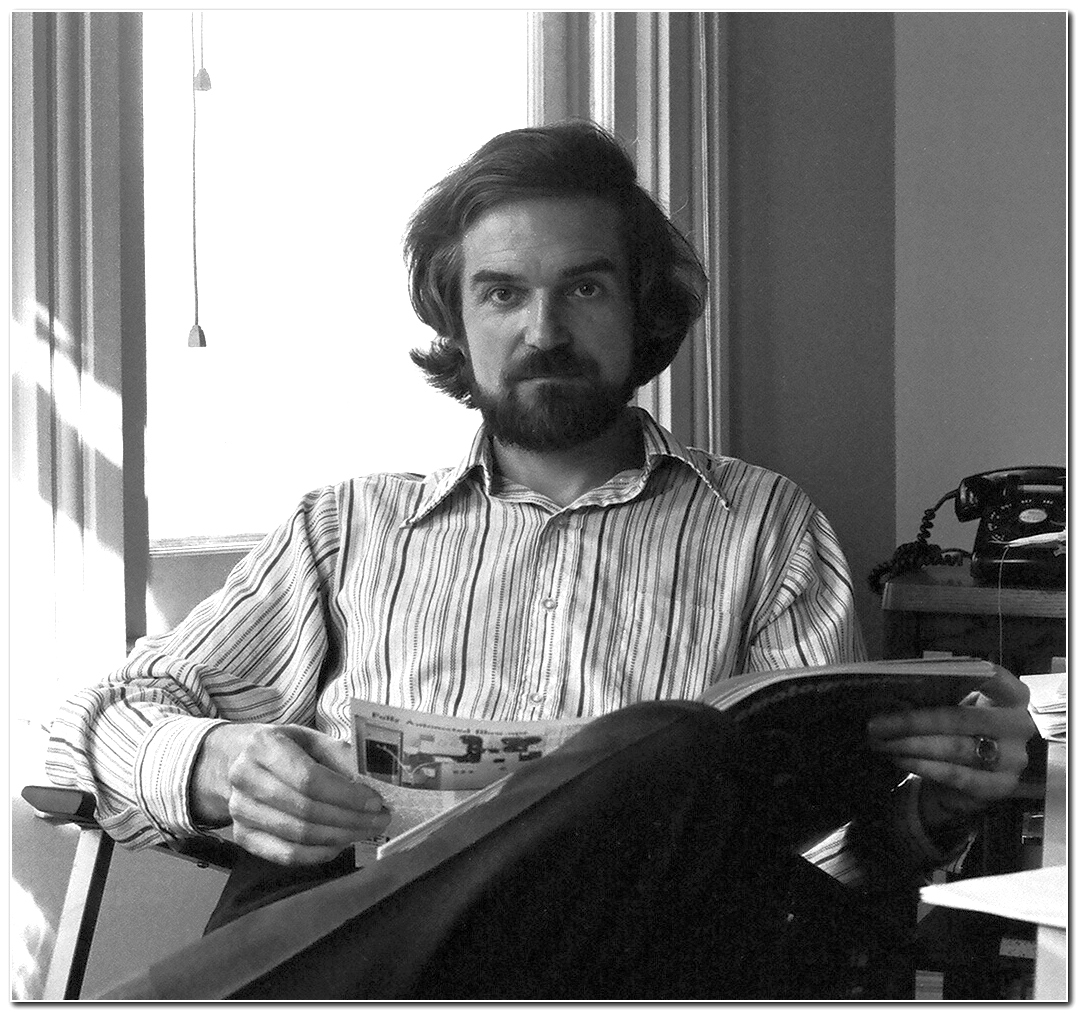 Robin Wood Robin Wood1931 - ROBIN WOOD, British-Canadian teacher, author, film theorist and critic, born (d: 2009); Wood was an secondary school English teacher who transformed the art of film criticism, especially through his appraisals of Howard Hawks, Arthur Penn, Ingmar Bergman, and in particular, Alfred Hitchcock. A “difficult child” he was frequently taken by the family maid to see movies to get him out of the house. This introduction to the silver screen lead to a life-long infatuation with Jean Arthur, Claudette Colbert and Cary Grant and film in general. While teaching English, he submitted an article on Alfred Hitchcock’s Psycho to the celebrated French cinema journal Cahier du Cínema. Wood championed a morally committed, ethical approach to criticism which only became more acute and pointed when he came out as a gay man in the 1970s. His writings were meant “To contribute, in however modest a way, to the possibility of social revolution, along lines suggested by radical feminism, Marxism and Gay Liberation.” The turning point in Wood's philosophical views can arguably be pinpointed in his essay Responsibilities of a Gay Film Critic, originally a speech at the National Film Theater and later printed in Film Comment magazine in 1978. It was subsequently included in the revised edition of his book Personal Views [Wayne State University Press: ISBN# 9780814332788.] But his chief fascination, and his reputation, was Alfred Hitchcock. “A lot of people thought it was ridiculous, this idea of taking Hitchcock seriously,” he said. “He was seen simply as an entertainer; one was merely amused by his films...a few shocks, a few laughs and that was it.” But to Wood, Hitchcock was more. “I think the best of Hitchcock films continue to fascinate me because he’s obviously right inside them, he understands so well the male drive to dominate, harass, control and at the same time he identifies strongly with the woman’s position.” Many of his students, including underground filmmaker and porn star Bruce LaBruce, have gone on to notable careers. Wood had been married and fathered three children. Wood was Toronto University’s York professor emeritus of film. He died of complications of Leukemia and is survived by his partner, Richard Lippe. Noteworthy 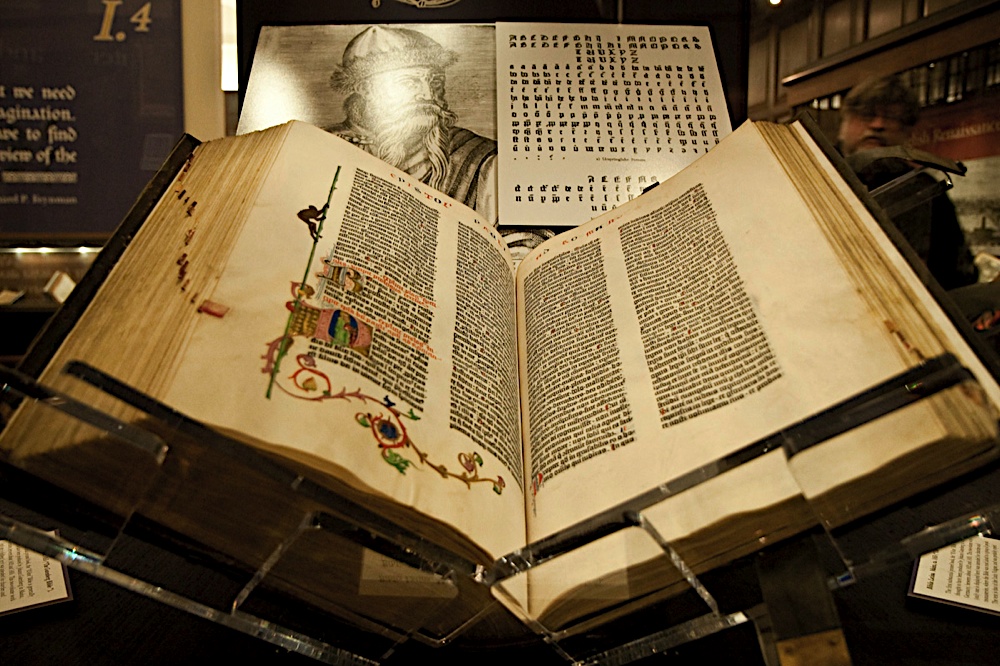 The Gutenberg Bible The Gutenberg Bible1455 - The traditional date for the publication of the GUTENBERG BIBLE, the first Western book printed from movable type thus transforming what had been an apocryphal transcription and imprecise oral tradition into rigid stone. While the Gutenberg Bible helped introduce printing to the West, the process was already well established in other parts of the world. Chinese artisans were pressing ink onto paper as early as the second century A.D., and by the 800s, they had produced full-length books using wooden block printing. Movable type also first surfaced in the Far East. Sometime around the mid-11th century, a Chinese alchemist named Pi Sheng developed a system of individual character types made from a mixture of baked clay and glue. Metal movable type was later used in Korea to create the “Jikji,” a collection of Zen Buddhist teachings. The Jikji was first published in 1377, some 75 years before Johannes Gutenberg began churning out his Bibles in Mainz, Germany. By studying the size of Gutenberg’s paper supply, historians have estimated that he produced around 180 copies of his Bible during the early 1450s. That may seem miniscule, but at the time there were probably only around 30,000 books in all of Europe. The splash that Gutenberg’s Bibles made is evident in a letter the future Pope Pius II wrote to Cardinal Carvajal in Rome. In it, he raves that the Bibles are “exceedingly clean and correct in their script, and without error, such as Your Excellency could read effortlessly without glasses.” Most Gutenberg Bibles contained 1,286 pages bound in two volumes, yet almost no two are exactly alike. Of the 180 copies, some 135 were printed on paper, while the rest were made using vellum, a parchment made from calfskin. Due to the volumes’ considerable heft, it has been estimated that some 170 calfskins were needed to produce just one Gutenberg Bible from vellum. Out of some 180 original printed copies of the Gutenberg Bible, 49 still exist in library, university and museum collections. Less than half are complete, and some only consist of a single volume or even a few scattered pages. Germany stakes the claim to the most Gutenberg Bibles with 14, while the United States has 10, three of which are owned by the Morgan Library and Museum in Manhattan. The last sale of a complete Gutenberg Bible took place in 1978, when a copy went for a cool $2.2 million. A lone volume later sold for $5.4 million in 1987, and experts now estimate a complete copy could fetch upwards of $35 million at auction. | ||||
|
|8|O|8|O|8|O|8|O|8|O|8|O|8|O|8| Gay Wisdom for Daily Living from White Crane Institute "With the increasing commodification of gay news, views, and culture by powerful corporate interests, having a strong independent voice in our community is all the more important. White Crane is one of the last brave standouts in this bland new world... a triumph over the looming mediocrity of the mainstream Gay world." - Mark Thompson Exploring Gay Wisdom & Culture since 1989! |8|O|8|O|8|O|8|O|8|O|8|O|8|O|8| | ||||

|
|||||

|
