|
Gay Wisdom for Daily Living brought to you by White Crane Institute ͏ ͏ ͏ ͏ ͏ ͏ ͏ ͏ ͏ ͏ ͏ ͏ ͏ ͏ ͏ ͏ ͏ ͏ ͏ ͏ ͏ ͏ ͏ ͏ ͏ ͏ ͏ ͏ ͏ ͏ ͏ ͏ ͏ ͏ ͏ ͏ ͏ ͏ ͏ ͏ ͏ ͏ ͏ ͏ ͏ ͏ ͏ ͏ ͏ ͏ ͏ ͏ ͏ ͏ ͏ ͏ ͏ ͏ ͏ ͏ ͏ ͏ ͏ ͏ ͏ ͏ ͏ ͏ ͏ ͏ ͏ ͏ ͏ ͏ ͏ ͏ ͏ ͏ ͏ ͏ ͏ ͏ ͏ ͏ ͏ ͏ ͏ ͏ ͏ ͏ ͏ ͏ ͏ ͏ ͏ ͏ ͏ ͏ ͏ ͏ ͏ ͏ ͏ ͏ ͏ ͏ ͏ ͏ ͏ ͏ ͏ ͏ ͏ ͏ ͏ ͏ ͏ ͏ ͏ ͏ ͏ ͏ ͏ ͏ ͏ ͏ ͏ ͏ ͏ ͏ ͏ ͏ ͏
|
|
||||
| This Day in Gay History | ||||
March 28Born 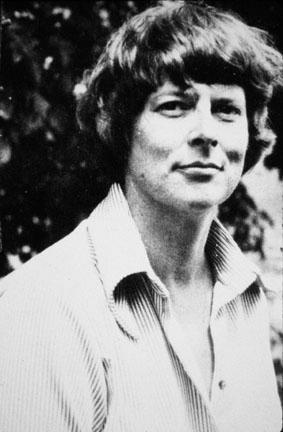 Jane Rule Jane Rule1931 - JANE RULE, Canadian novelist, born, (d: 2007); A writer of Lesbian-themed novels and non-fiction this Canadian teacher wrote several acclaimed works of fiction, including This Is Not For You and Against the Season. But the essential Jane Rule can be seen most directly in her remarkable book, Lesbian Images (1975) in which she attempts to set down nothing less than what it means to be a Lesbian. She realized this aim beautifully by measuring her own attitudes toward the Lesbian experience against the images made by other women writers, including Gertrude Stein, Willa Cather, Radclyffe Hall, Vita Sackville-West, Elizabeth Owen and Maureen Duffy among others. When Rule’s first novel, The Desert of the Heart was published in 1964, a critic complaining of the Lesbian subject matter wrote, “But all the time you keep turning to the photograph of the author on the jacket and wondering how could such a nice looking woman have chosen so distasteful a subject.” Read Lesbian Images not only to discover why she writes on “so distasteful a subject,” but for a compassionate explanation of how any critic could have written anything so terribly terribly sad. Rule served on the executive of the Writer’s Union of Canada. She was an outspoken advocate of both free speech and gay rights, included in the various controversies surrounding the Gay magazine The Body Politic. In 1989, Rule donated a collection of her writings to the University of British Columbia. Rule was inducted into the Order of British Columbia in 1998 and into the Order of Canada in 2007. She remarked, "I chose Canada over 50 years ago. So it is very nice to have Canada choose me," about receiving the honor. Memory Board (1987) and After the Fire (1989) were both nominated for the Ethel Wilson Fiction Prize. Rule and Sontoff lived together until Sontoff's death in 2000. Rule surprised some in the Gay community by declaring herself against same-sex marriage equality, writing, "To be forced back into the heterosexual cage of coupledom is not a step forward but a step back into state-imposed definitions of relationship. With all that we have learned, we should be helping our heterosexual brothers and sisters out of their state-defined prisons, not volunteering to join them there." Rule died at the age of seventy-six on November 27, 2007 at her home on Galiano Island due to complications from liver cancer, refusing any treatment that would take her from the island. 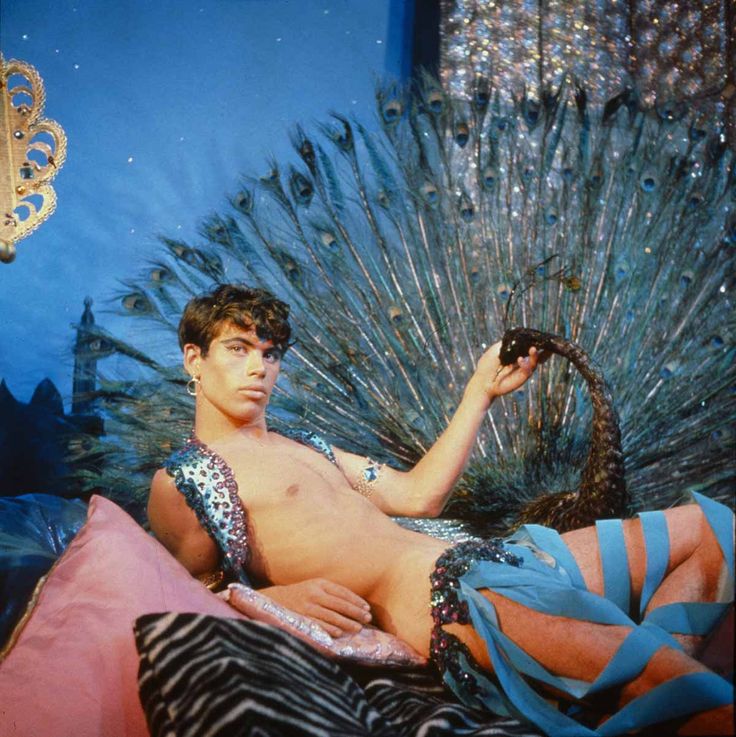 Image from James Bidgood's "Pink Narcissus" Image from James Bidgood's "Pink Narcissus"1933 - American artist, filmmaker and legend, JAMES BIDGOOD was born on this date in Madison Wisconsin. His artistic output has embraced a number of media and disciplines, including music, set and window design, and drag performance. In time his interests led him to photography and film and it is for this work that he is most widely known. Highly recognizable, his photographs are distinguished by an aesthetic of high fantasy and camp. His work which was inspired by an early interest in Florenz Ziegfeld, Folies Bergere and George Quaintance has, in turn, served as important inspiration for a slew of artists including Pierre et Gilles and David LaChapelle. In the late 1950s Bidgood attended Parsons The New School for Design. He directed the 1971 film Pink Narcissus, a dialogue-free fantasy centered around a young and often naked man. The film took seven years to make, and Bidgood built all the sets and filmed the entire piece in his tiny apartment. He later removed his name from the film because he felt editors had changed his original vision. Consequently, the film bore the word "Anonymous" for the director's credit, and it was mis-attributed to other directors such as Andy Warhol for many years. Pink Narcissus was re-released in 2003 by Strand Releasing His work is characterized by a heavy reliance on invention. His photographs feature elaborate sets built ground up from the materials of the theater, fashion, design and fine art. In a profile of the artist published in Aperture, Philip Gefter writes, Necessity was the mother of invention for Bidgood, who created elaborate photographic tableaux in his small midtown Manhattan studio apartment. His first erotic series was an underwater epic called Water Colors, made in the early 1960s, in which he used a dancer from Club 82 named Jay Garvin as his subject. The underwater atmosphere is completely fabricated; the bottom of the ocean was created with silver lame spread across the floor of Bidgood's apartment; he made the arch of a cave out of waxed paper, and fashioned red lame into the shape of lobster. He coated Garvin with mineral oil and pasted glitter and sequins to his skin so the silver fabric under photographic lights would reflect on his body like water. For weeks at a time, Bigood would eat and sleep within the sets he constructed in his apartment Many contemporary themes are found even in the earliest of Bidgood's work. Camp, identity, erotics and desire, marginality, and performance all figure heavily in his portraits of nude men. Bidgood's complex references to the theatre and performance seem to presage Queer articulations of Performance. His techniques, working processes, and masterful use of illusionistic color indicate both a mature understanding of his influences and goals and an important contrast to the art movements of the time the work was first created. In 2005, James Bidgood was honored with a Creative Capital grant which facilitated a return to art photography after a hiatus of nearly forty years. His current projects include work for Christian Louboutin and OUT magazine. In 1999 Taschen published a monograph of his work including biographical images and stills from his film. The art book publisher Taschen included an interview with Bidgood in its 2008 publication The Big Penis Book, and will re-publish his monograph in 2009. His most recent work was featured in Out in February 2009.  Author Kevin Sessums Author Kevin Sessums1956 - Author, editor and actor KEVIN SESSUMS was born on this date; Sessums has served as executive editor of Interview and as a contributing editor of Vanity Fair, Allure, and Parade. His work has also appeared in Travel+Leisure, Elle, Out, Marie Claire, Playboy, Thedailybeast.com and Towleroad.com. He was the founding Editor-in-Chief of FourTwoNine ("g" "a" "y" on the keypad) magazine and was the Editor at Large of the Curran in San Francisco. He has recently returned to the East Coast. In 2007, Sessums published a memoir titled Mississippi Sissy, which is about the conflicted life of a self-aware gay boy growing up in Forest, Mississippi. It made the New York Times Bestseller list and won the 2008 Lambda Literary Award for Best Male Memoir. His audio recording of Mississippi Sissy was nominated for a 2007 Quill Award. In 2015, he published his second memoir, I Left It on the Mountain, which made the New York Times Celebrity Bestseller List. Sessums portrayed the character Peter Cipriani in the miniseries adaptation of Armistead Maupin’s Tales of the City. Sessums was banned from posting on Facebook for 24 hours on December 29, 2016 after he accurately compared the supporters of President-elect Donald Trump to a "nasty fascistic lot" in a post. The company subsequently issued an apology. As well they should. Died 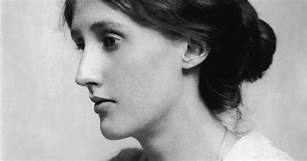 Virginia Woolf Virginia Woolf1941 - VIRGINIA WOOLF, English feminist writer, died (b. 1882); English novelist and essayist regarded as one of the foremost modernist literary figures of the 20th century. During the interwar period, Woolf was a significant figure in London literary society and a member of the Bloomsbury Group. Her most famous works include the novels Mrs. Dalloway (1925), To The Lighthouse (1927), andOrlando (1928) and the book-length essay A Room of One’s Own (1929) with its famous dictum, "a woman must have money and a room of her own if she is to write fiction." After completing the manuscript of her last (posthumously published) novel Between the Acts, Woolf fell victim to a depression similar to that which she had earlier experienced. The war, the Luftwaffe's destruction of her London homes, as well as the cool reception given to her biography of her late friend Roger Fry, worsened her condition until she was unable to work. The ethos of Bloomsbury discouraged sexual exclusivity, and in 1922, Woolf met Vita Sackville-West. After a tentative start, they began a relationship that lasted through most of the 1920s. In 1928, Woolf presented Sackville-West with Orlando, a fantastical biography in which the eponymous hero's life spans three centuries and both genders. It has been called by Nigel Nicolson, Sackville-West's son, "the longest and most charming love letter in literature." After their affair ended, the two women remained friends until Woolf's death. On March 28th 1941, rather than having another nervous breakdown, Woolf drowned herself by weighing her pockets with stones and walking into the River Ouse near her home. Her body was not found until April 18th. Her husband buried her remains under a tree in the garden of their house in Rodmell, Sussex. In her last note to her husband she wrote: “I feel certain that I am going mad again. I feel we can't go through another of those terrible times. And I shan't recover this time. I begin to hear voices, and I can't concentrate. So I am doing what seems the best thing to do. You have given me the greatest possible happiness. You have been in every way all that anyone could be. I don't think two people could have been happier 'til this terrible disease came. I can't fight any longer. I know that I am spoiling your life, that without me you could work. And you will I know. You see I can't even write this properly. I can't read. What I want to say is I owe all the happiness of my life to you. You have been entirely patient with me and incredibly good. I want to say that—everybody knows it. If anybody could have saved me it would have been you. Everything has gone from me but the certainty of your goodness. I can't go on spoiling your life any longer. I don't think two people could have been happier than we have been.” 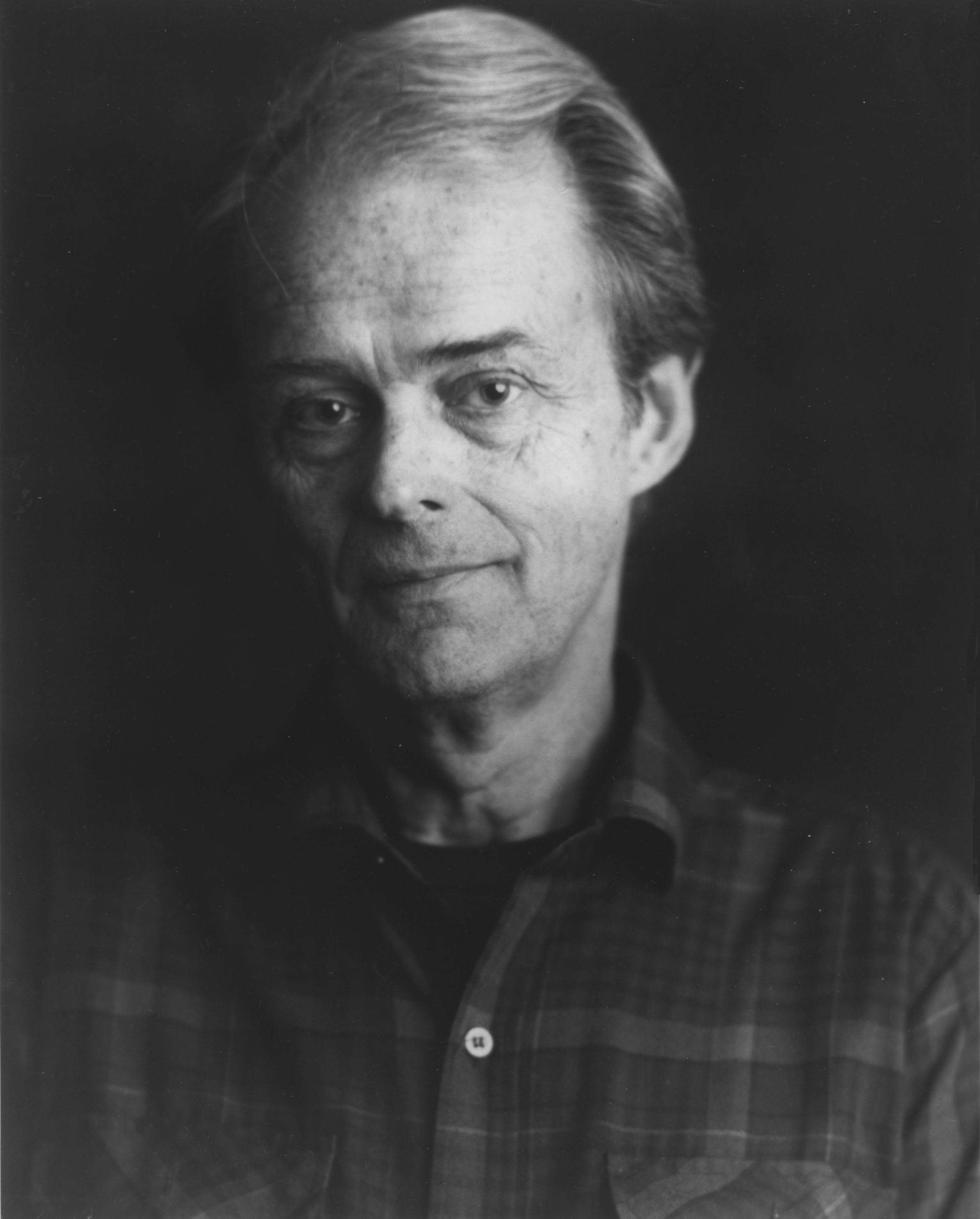 Lee Hoiby Lee Hoiby2011 - LEE HOIBY, an American composer of operas and songs that balanced unabashed lyricism and careful craftsmanship died (b: 1926); Born in Madison, Wisconsin, Hoiby was a child prodigy who began playing the piano at the age of five. He studied at the University of Wisconsin under notable pianists Gunnary Johansen and Egon Petri. He then became a pupil of Darius Milhaud at Mills College. Hoiby became influenced by a variety of composers, particularly personalities in the 20th century avant garde, including the Pro Arte String Quartet led by Rudolf Kolisch, son-in-law of Arnold Schoenberg. During his youth, Hoiby played with Harry Partch’s Dadaist ensembles. Following his studies at Mills College, he entered the Curtis Institute of Music where he was mentored in music composition by Gian Carlo Menotti, who introduced Hoiby to opera, and involved him in the Broadway productions of The Consul and The Saint of Bleecker Street. Though at first he intended to pursue a career as a concert pianist, he eventually became more interested in composing. Mr. Hoiby’s style – sophisticated yet straightforward, emotional but never sentimental – deepened while remaining constant. During the 1960s and 1970s, as serial composition became the establishment standard, his work was considered unfashionable. But as tonality regained its popularity his music seemed less reactionary than timeless. Hoiby is best remembered for more than 100 songs, to texts (many selected by his life partner, Mark Shulgasser, who survives him) ranging from Elizabeth Bishop and Wallace Stevens to Rilke and Donne. One of his major advocates was Leontyne Price who for more than thirty years sang his songs in her recitals. He compared composing to archaeology, “It requires patient digging, searching for the treasure...the ability to distinguish between a treasure and the rock next to it and recognizing when you’re digging in the wrong direction. The archaeologist takes a soft brush and brushes away a half-teaspoon at a time. Musically, that would be a few notes, or a chord. Sometimes the brushing reveals an especially lovely thing, buried there for so long.” | ||||
|
|8|O|8|O|8|O|8|O|8|O|8|O|8|O|8| Gay Wisdom for Daily Living from White Crane Institute "With the increasing commodification of gay news, views, and culture by powerful corporate interests, having a strong independent voice in our community is all the more important. White Crane is one of the last brave standouts in this bland new world... a triumph over the looming mediocrity of the mainstream Gay world." - Mark Thompson Exploring Gay Wisdom & Culture since 1989! |8|O|8|O|8|O|8|O|8|O|8|O|8|O|8| | ||||

|
|||||

|
