|
Gay Wisdom for Daily Living brought to you by White Crane Institute ͏ ͏ ͏ ͏ ͏ ͏ ͏ ͏ ͏ ͏ ͏ ͏ ͏ ͏ ͏ ͏ ͏ ͏ ͏ ͏ ͏ ͏ ͏ ͏ ͏ ͏ ͏ ͏ ͏ ͏ ͏ ͏ ͏ ͏ ͏ ͏ ͏ ͏ ͏ ͏ ͏ ͏ ͏ ͏ ͏ ͏ ͏ ͏ ͏ ͏ ͏ ͏ ͏ ͏ ͏ ͏ ͏ ͏ ͏ ͏ ͏ ͏ ͏ ͏ ͏ ͏ ͏ ͏ ͏ ͏ ͏ ͏ ͏ ͏ ͏ ͏ ͏ ͏ ͏ ͏ ͏ ͏ ͏ ͏ ͏ ͏ ͏ ͏ ͏ ͏ ͏ ͏ ͏ ͏ ͏ ͏ ͏ ͏ ͏ ͏ ͏ ͏ ͏ ͏ ͏ ͏ ͏ ͏ ͏ ͏ ͏ ͏ ͏ ͏ ͏ ͏ ͏ ͏ ͏ ͏ ͏ ͏ ͏ ͏ ͏ ͏ ͏ ͏ ͏ ͏ ͏ ͏ ͏
|
|
||||
| This Day in Gay History | ||||
April 13Born 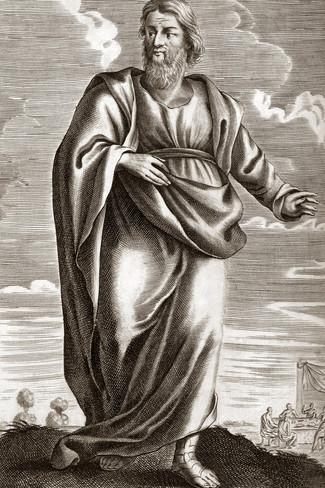 Aristippus of Cyrene Aristippus of Cyrene0435 BCE - ARISTIPPUS, of CYRENE, Greek philosopher, born (d: 360 BCE); Well…you know…you get that far back in the calendar, and…there’s just no way of knowing. was the founder of the Cyrenaic school of Philosophy. He was a pupil of Socrates, but adopted a very different philosophical outlook, teaching that the goal of life was to seek pleasure by adapting oneself to circumstances and by maintaining proper control over both adversity and prosperity. Aristippus held that the highest purpose and virtue was the pursuit of pleasure. And wouldn’t you just know that the founder of hedonism would be Gay as a goose, history having recorded the name of his favorite, Eutichydes, who assuredly must have kept Aristippus good and virtuous and pleasured  Playwright Lanford Wilson Playwright Lanford Wilson1937 - Today was the birthday of the award winning playwright LANFORD WILSON. (d: 2011) Considered one of the founders of the Off-off Broadway theater movement, Wilson received the Pulitzer Prize for Drama in 1980, was elected in 2001 to the Theater Hall of Fame and in 2004 was elected to the American Academy of Arts and Letters. Wilson began his active career as a playwright in the early 1960s at the Caffe Cino in Greenwich Village, writing one-act plays such as Ludlow Fair, Home Free!, and The Madness of Lady Bright. The Madness of Lady Bright premiered at the Caffe Cino in May of 1964 and was the venue's first significant hit. The play featured actor Neil Flanagan in the title role as Leslie Bright, a neurotic aging queen. The Madness of Lady Bright is considered a landmark play in the representation of male homosexuality. It was the longest running play ever to appear at the Caffe Cino, where it was performed over two hundred times. Wilson was subsequently invited to present his work off-Broadway, including his plays Balm in Gilead and The Rimers of Eldritch. Wilson was a founding member of the Circle Repertory Company in 1969. Many of his plays were first presented there, directed by his long-standing collaborative partner, Marshall W. Mason. The Circle Rep's production of Wilson's The Hot l Baltimore won the New York Drama Critics' Circle Award, the Outer Critics Circle Award, and the Obie Award, and in 1979 he received the Pulitzer Prize for Drama for Talley's Folly. Wilson's style and approach evolved over the years, sometimes resulting in drastically different effects. Some of his plays are extremely radical and experimental in nature while others clearly have a more mainstream, if still creative, sensibility. His first full length play, Balm in Gilead, is perhaps his most radical, yet it also remains one of his most popular. The play had a memorable off-Broadway revival in the 1980s, directed by John Malkovich, a co-production of Circle Rep and the Steppenwolf Theatre Company. In addition to writing plays, Wilson wrote the texts for several 20th century operas, including at least two collaborations with composer Lee Hoiby:Summer and Smoke (1971) and This is the Rill Speaking (1992) (based on his own play). Wilson died March 23rd this year. 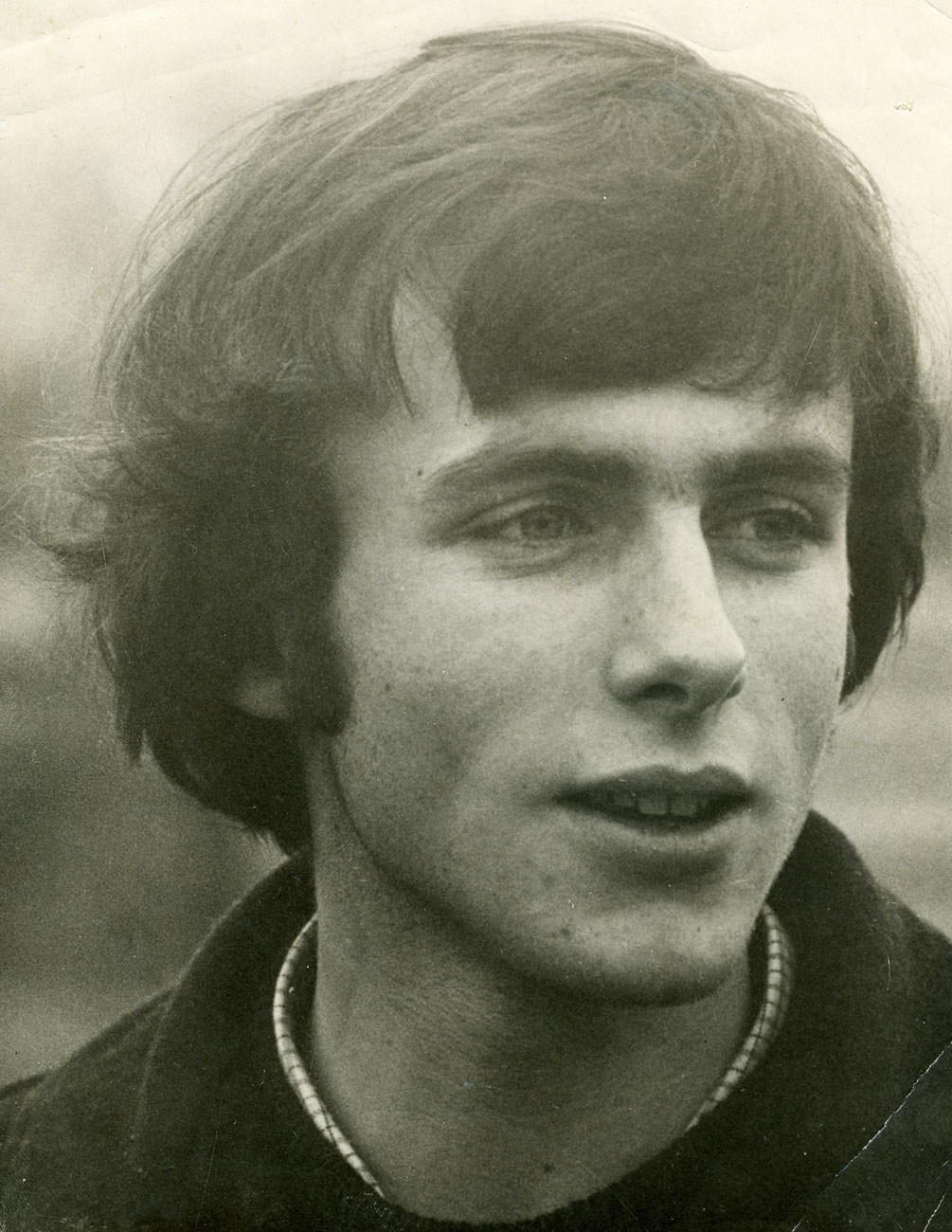 Young Christopher Hitchens Young Christopher Hitchens1949 - CHRISTOPHER HITCHENS, English author and journalist, born (d: 2011); His books, and a prolific journalistic career that spanned more than four decades, made him a prominent public intellectual and a staple of talk shows, lectures and punditry. He was a columnist and literary critic at The Atlantic, Vanity Fair, Slate, World Affairs, The Nation and Free Inquiry and a variety of other media outlets. Mr. Hitchens was a political observer, polemicist and self-defined radical with an astute historical knowledge, Hitchens rose to prominence as a fixture of the left-wing publications of both his native United Kingdom and the U.S. His departure from the established political left began in 1989 after what he called the "tepid reaction" of the European left following Ayatollah Khomeini’s issue of a fatwa, calling for the murder of author Salman Rushdie. Mr. Hitchens was an outspoken atheist and identified as being a prominent exponent of the "new atheism" movement. He and fellow high profile contemporary atheists Richard Dawkins, Sam Harris and Daniel Dennett were often been referred to as "The Four Horsemen" and the "Unholy Trinity". Hitchens was a secular humanist and an anti-theist and described himself as a believer in the philosophical values of the Age of Enlightenment. His main argument was that the concept of God or a supreme being is a totalitarian belief that destroys individual freedom, and that free expression and scientific discovery should replace religion, which inhibits it, as a means of teaching ethics and defining human civilization. He wrote at length on atheism, the nature of religion, and their corresponding effects on society, in the 2007 book God Is Not Great. In 1994, Hitchens made a documentary for BBC called Hell’s Angel. It was a bold and highly controversial investigation of Mother Teresa of Calcutta, vaunted by many devotees as a saint. Prior to Hitchens’ critique, almost every book or film about Teresa portrayed her as a holy icon, worthy of reverence, a hero of charity on behalf of the wretched of the earth. But the great iconoclast Hitchens, in his book The Missionary Position – Mother Teresa in Theory and in Practise, dared to ask some inconvenient questions about Mother Teresa. Hitchens discovers that Mother Teresa’s career was far from spotless and immaculately clean: by “keeping company with several frauds, crooks and exploiters” (HITCHENS, p. 8), she managed to amass millions of dollars in donations from some very wicked sources. In his book The Unbelievers – The Evolution of Modern Atheism, whose last chapter is dedicated to Hitchens, J. T. Joshi remembers some of the revelations about Teresa’s questionable funding process and suspiciously well-furnished bank accounts: "Charles Keating for instance, donated more than $1 million bucks to her – much or all of it gained from his avowedly criminal activities in the savings and loan scandals of the 1980s. (…) Perhaps some of this can be excused by her need to drum up charitable contribuitons from all possible sources for her Missionaries of Charity. But there seems to be much more to it. Why was she so keen on hanging around such lowlives as the visious dictator Hean-Claude ("Baby Doc") Duvalier of Haiti? (…) This behaviour might be forgiven if the charity work that Mother Teresa was doing in Calcutta for decades were actually worth doing – but of even this there are strong doubts. Her devotion to the poor, the diseased, and the friendless would seem to be exemplary of the best that religion can do. Why is it that, even though one of her many bank accounts (this one in Utah) contained the sum of $50 million, her hospitals around the world were so poorly equipped?” Though married, on a 2009 edition of Morning Joe on MSNBC, Hitchens discussed his same-sex affairs as a young man, some with individuals now prominent in the U.K. political scene. His memoir, Hitch-22, was published in June 2010. Touring for the book was cut short later in the same month so he could begin treatment for newly diagnosed esophageal cancer. On December 15, 2011, Hitchens died from pneumonia, a complication of his cancer, in Houston, Texas. I, for one, miss his razor sharp intelligent, iconoclastic voice.  Terry Lester Terry Lester 1950 - TERRY LESTER, American actor (d. 2003); Lester was born in Indianapolis, Indiana and began an acting career while at DePauw University in Greencastle, Indiana. After years of musical theater, concert performances, numerous prime time TV guest roles, and a season starring in the 1976 children's series Ark II, Lester had his big break when he joined CBS daytime soap The Young and the Restless (Y&R) in 1980. He created the role of Jack Abbott, a scoundrel who never met a woman (including his own father's wife) he didn't want to take to bed. Lester was so popular that Y&R creator William J. Bell wrote an entire family for him. Y&R was going through a transition period at this time and many fans believe that Lester's star quality helped the show build more viewers and eventually rise to #1 in the daytime soap ratings. Lester kept his personal life under wraps but a 2003 L.A. Magazine article on former soap star Thom Bierdz outed Lester along with Michael Corbett and Bierdz, who made up a trio of Gay actors who worked on Y&R in the 1980s. Noteworthy 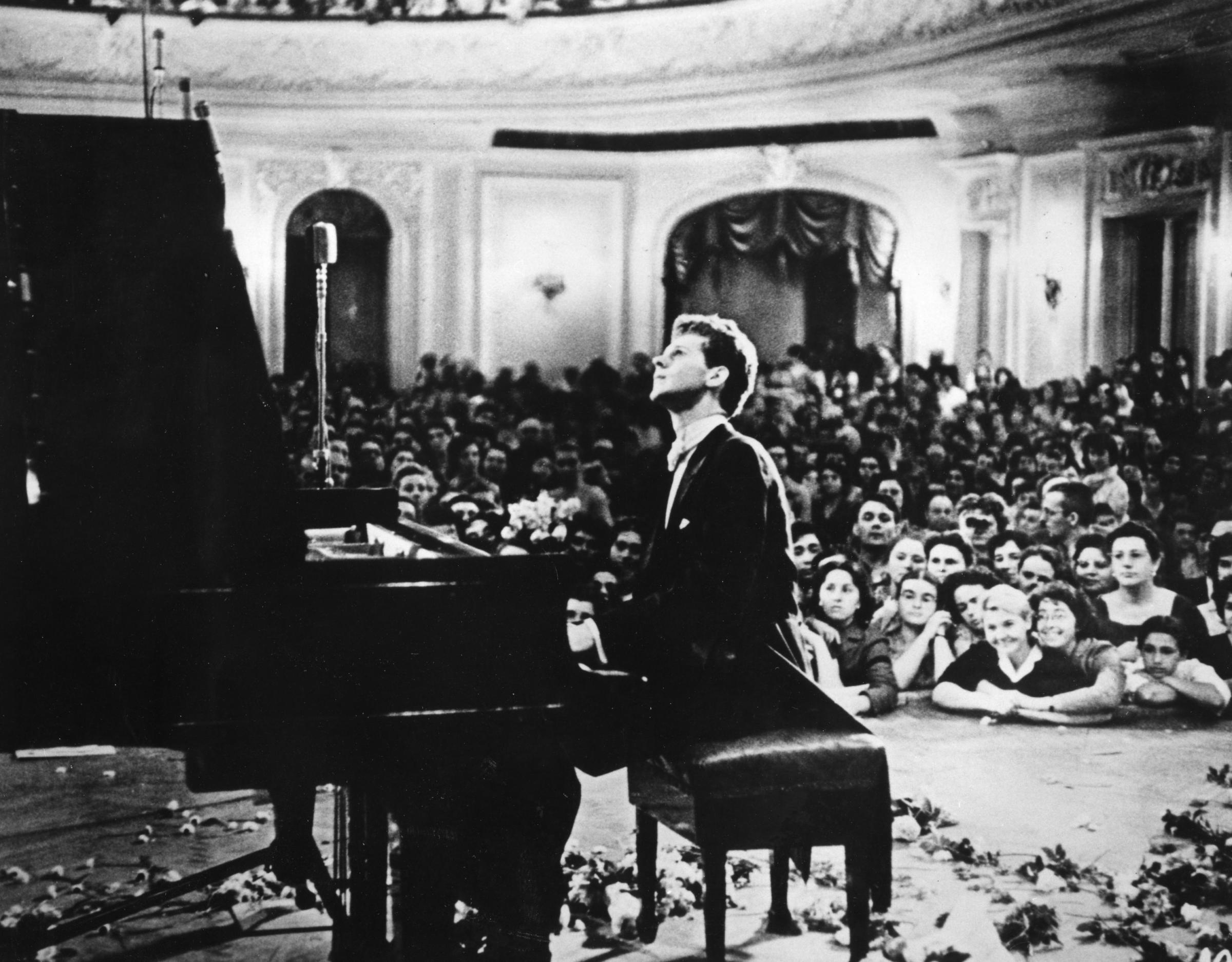 Van Cliburn in Russia Van Cliburn in Russia1958 - On this date HARVEY LAVAN "VAN" CLIBURN JR. achieved worldwide recognition by becoming the first American to win the International Tchaikovsky Piano Competition in Moscow. He was all of 23. The competition was designed to demonstrate Soviet cultural superiority during the Cold War, on the heels of their technological victory with the Sputnik launch in October 1957. Cliburn's performance at the competition finale of Tchaikovsky's Piano Concerto No. 1 and Rachmaninoff's Piano Concerto No. 3 earned him a standing ovation lasting eight minutes. When it was time to announce a winner, the judges were obliged to ask permission of the Soviet leader Nikita Khrushchev to give first prize to an American. "Is he the best?" Khrushchev asked. "Then give him the prize!" Cliburn returned home to a ticker-tape parade in New York City, the only time the honor has been accorded a classical musician. His cover story in Time proclaimed him "The Texan Who Conquered Russia." 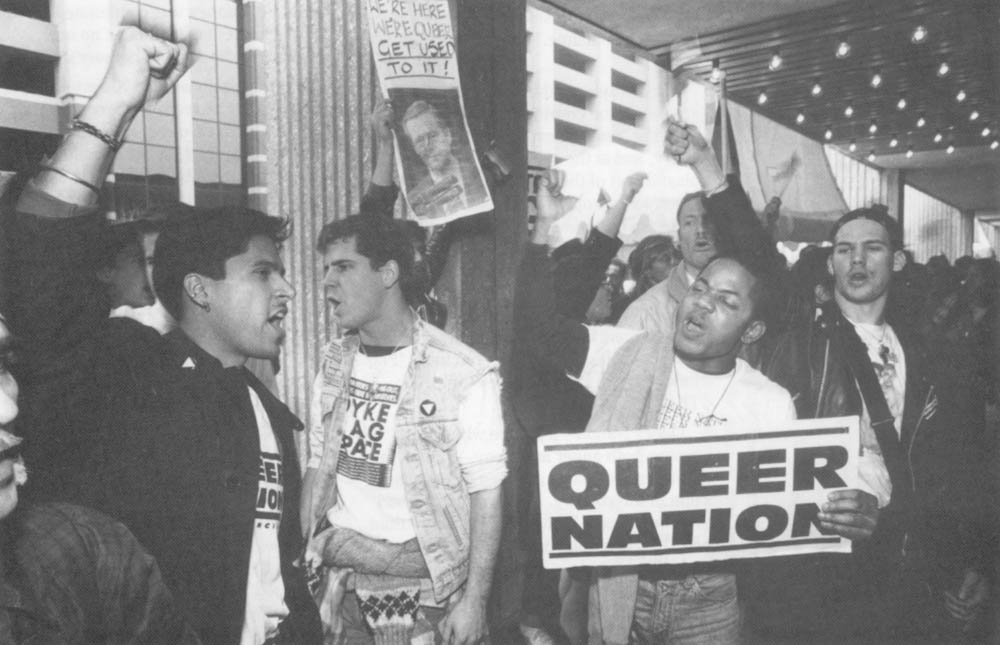 Queer Nights Out! Queer Nights Out!1990 - QUEER NATION, the direct-action group's inaugural action took place at Flutie's Bar, a straight hangout at the South Street Sea Port on April 13, 1990. The goal: to make clear to patrons that queers will not be restricted to Gay bars for socializing and for public displays of affection. More visibility actions like this one became known as "Queer Nights Out."  2017 - Vaisakhi (Punjabi; also known as Baisakhi) is an ancient harvest festival in Punjab, which also marks beginning of a new solar year, and new harvest season. Baisakhi also has religious significance for Hindus and Sikhs. It falls on the first day of the Vaisakh month in the solar Nanakshahi calendar, which corresponds to April 14 in the Gregorian calendar. Vaisakhi is one of the most significant holidays in Sikh calendar, commemorating the establishment of the Khalsa in 1699; which marks the Sikh New Year. It also is observed as the beginning of the new year by Indians in West Bengal, Kerala, and some other regions of India. The particular significance attached to the occasion shows regional variation outside of Punjab. In Himachal Pradesh, Hindu Goddess Jwalamukhi is worshipped on Vaisakhi, while in Bihar, Sun-god Surya is honored. The festival is celebrated as Rongali Bihu in Assam, Naba Barsha in Bengal, Puthandu in Tamil Nadu, Vishnu (or Vaishakhi) in Kerala, and the Sinhalese/Tamil new year festival in Sri Lanka. Besides Punjab, Vaisakhi is widely celebrated as a harvest festival in other northern states of India, such as Haryna, Himachal Pradesh and Uttarachal. | ||||
|
|8|O|8|O|8|O|8|O|8|O|8|O|8|O|8| Gay Wisdom for Daily Living from White Crane Institute "With the increasing commodification of gay news, views, and culture by powerful corporate interests, having a strong independent voice in our community is all the more important. White Crane is one of the last brave standouts in this bland new world... a triumph over the looming mediocrity of the mainstream Gay world." - Mark Thompson Exploring Gay Wisdom & Culture since 1989! |8|O|8|O|8|O|8|O|8|O|8|O|8|O|8| | ||||

|
|||||

|
