|
Gay Wisdom for Daily Living brought to you by White Crane Institute ͏ ͏ ͏ ͏ ͏ ͏ ͏ ͏ ͏ ͏ ͏ ͏ ͏ ͏ ͏ ͏ ͏ ͏ ͏ ͏ ͏ ͏ ͏ ͏ ͏ ͏ ͏ ͏ ͏ ͏ ͏ ͏ ͏ ͏ ͏ ͏ ͏ ͏ ͏ ͏ ͏ ͏ ͏ ͏ ͏ ͏ ͏ ͏ ͏ ͏ ͏ ͏ ͏ ͏ ͏ ͏ ͏ ͏ ͏ ͏ ͏ ͏ ͏ ͏ ͏ ͏ ͏ ͏ ͏ ͏ ͏ ͏ ͏ ͏ ͏ ͏ ͏ ͏ ͏ ͏ ͏ ͏ ͏ ͏ ͏ ͏ ͏ ͏ ͏ ͏ ͏ ͏ ͏ ͏ ͏ ͏ ͏ ͏ ͏ ͏ ͏ ͏ ͏ ͏ ͏ ͏ ͏ ͏ ͏ ͏ ͏ ͏ ͏ ͏ ͏ ͏ ͏ ͏ ͏ ͏ ͏ ͏ ͏ ͏ ͏ ͏ ͏ ͏ ͏ ͏ ͏ ͏ ͏
|
|
||||
| This Day in Gay History | ||||
August 21Born 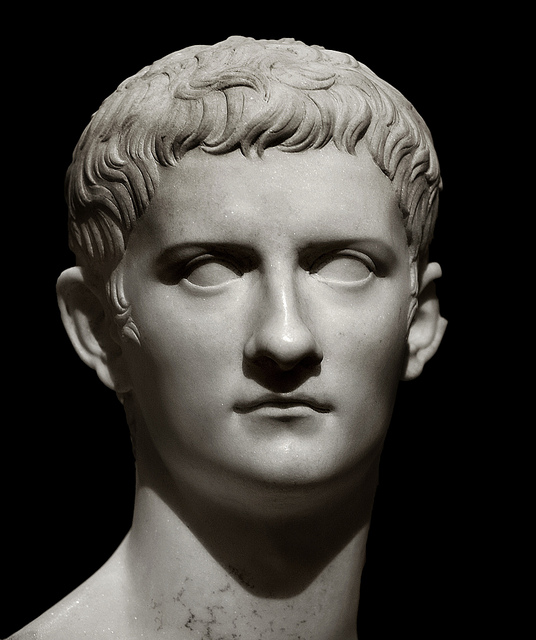 Caligula Caligula0012 - CALIGULA (ne Gaius Caesar Germanicus) Roman emperor, born (d: 41 C.E.); Caligula was a member of the house of rulers conventionally known as the Julio-Claudian dynasty. Caligula's father Germanicus, the nephew and adopted son of Emperor Tiberius, was a very successful general and one of Rome's most beloved public figures. The young Gaius earned the nickname “Caligula” (which translates as “little sandals”) from his father's soldiers while accompanying him during his campaigns in Germania. When Germanicus died at Antioch in 19 AD, his wife Agrippina the Elder returned to Rome with her six children where she became entangled in an increasingly bitter feud with Tiberius. This conflict eventually led to the destruction of her family, with Caligula as the sole male survivor. Unscathed by the deadly intrigues, Caligula accepted the invitation to join the emperor on the island of Capri in 31 AD, where Tiberius himself had withdrawn five years earlier. At the death of Tiberius in 37 AD, Caligula succeeded his great-uncle and adoptive grandfather Back in the dim 1950s, the epidemic of biblical and classical extravaganzas from Hollywood reached a new height, or low, depending on one’s point of view. One learned all sorts of interesting things about the past from these flicks (to say nothing of how they shape the persistent modern American myth). All women in classical Rome, for example, whether free born or slave, wore the same kiss-proof lipstick; many spoke with a hard-edged Bronx bray and were sentenced to death of their two-piece dancing togas were not sufficiently high to cover any hint of navel; were tortured if caught on the streets of Rome without sandals that were laced provocatively to the thigh. During this epic period, actor Jay Robinson offered two scenery-chewing performances as the mad emperor Caligula in two 20th Century Fox epics, The Robe and its sequel, Demetrius and the Gladiators. So effective was Robinson in his epicene camping, his evil vamping, his insane torture of innocent (??) Christian Hollywood extras, that by the time he threw his 85th Christian to a couple of toothless lions, one small child, biting his fingernails, leapt to his feet in a crowded theater and exclaimed “Boy, am I glad I’m Jewish!” Actually Robinson’s behavior was not too different from the behavior of the real Caligula. Only Heliogabalus seems to have outdone him in licentiousness. If it moved, Caligula wanted it, male or female. His taste in women was certainly catholic, since it included his sisters. His taste in men was equally far-ranging and included a priest whom he enjoyed screwing in public during religious ceremonies, an actor with whom he enjoyed smooching during meetings of state, a stud with whom he maintained a friendly contest as to who would outlast the other in a friendly orgy, and an officer in his guards whose buns he particularly admired. It was the latter, a guard named Chaerea, with whom he came a cropper. Part of Caligula’s fun with Chaerea consisted of taunting him in front of his peers for having bottomed to his top. The lovely emperor would regularly force his guard to kiss his middle finger in public. To repay Caligula for his sensitive kindness, Chaerea hacked him to death with his sword and finished off what was left of him with his dagger. Caligula was 29.  Aubrey Beardsley Aubrey Beardsley1872 - AUBREY BEARDSLEY, English illustrator was born (d. 1898) Most of his images are done in ink, and feature large dark areas contrasted with large blank ones, and areas of fine detail contrasted with areas with none at all. Aubrey Beardsley was the most controversial artist of the Art Nouveau era, renowned for his dark, and perverse images and the grotesque erotica, which were the main themes of his later work. His most famous erotic illustrations were on themes of history and mythology, including his illustrations for Lysistrata and Salome. Beardsley illustrated Oscar Wilde's play Salome in 1893 for its French performance; it was performed in English the following year. He also produced extensive illustrations for books and magazines (e.g. for a deluxe edition of Sir Thomas Mallory's Le Morte d’Arthur) and worked for magazines like The Savoy and The Studio. Beardsley also wrote Under the Hill, an unfinished erotic tale based loosely on the legend of Tannhauser. Beardsley was a public character as well as a private eccentric. He said, "I have one aim — the grotesque. If I am not grotesque I am nothing." Wilde said he had "a face like a silver hatchet, and grass green hair." Although Beardsley was aligned with the homosexual clique that included Wilde and other English aesthetes, the details of his sexuality remain in question. Speculation about his sexuality include rumors of an incestuous relationship with his elder sister, Mabel, who may have borne his miscarried child.  LR: [above left] Harry Hay, [lower] Dale Jennings, Rudi Gernreich, unidentified-member, Bob Hull, Chuck Rowland, and Paul-Bernhard. Photo: John Gruber LR: [above left] Harry Hay, [lower] Dale Jennings, Rudi Gernreich, unidentified-member, Bob Hull, Chuck Rowland, and Paul-Bernhard. Photo: John Gruber1928 - JOHN GRUBER, the last surviving original member of the Mattachine Society, one of the earliest homophile organizations in the United States was born on this day (d: 2011); James Finley Gruber, Jr. was born in Des Moines, Iowa. A boy scout at 13, Gruber described himself as a “typical teenager” who enjoyed relations with both men and women, and considered himself bisexual. His unpublished manuscript, “The Deviant: an Illustrated Autobiography,” chronicles his life across the 20th century year by year, including references to movies, books, songs, newspaper clippings, and images of current events, movie stars, and family photographs. His father was a vaudeville performer and music instructor who, in his search for work, moved the family to Los Angeles in 1936. Enthralled with the glamour that Hollywood offered, the good-looking young man took acting, music and dancing lessons. In 1946, at the age of 18, Gruber enlisted in the U.S. Marines where, in close physical proximity to men for the first time, he “went bananas in the sex department.” He enjoyed the camaraderie of his fellow soldiers, even as he continued to have affairs with women, and was honorably discharged in 1949. Gruber majored in English Literature at Occidental College and in 1950 met Christopher Isherwood, who was to become a close friend and role model. “Chris was the man I aspired to be.” Chris introduced Gruber to W.H. Auden, who was impressed that John had read his work. Chris also introduced Gruber to his landlady, Evelyn Hooker, a therapist and professor of psychiatry at UCLA whose pioneering research on gay men contributed to a change in the attitudes of the psychological community towards homosexuality, leading to the American Psychiatric Association's 1973 decision to remove homosexuality from its handbook of disorders, and an increased acceptance by society at large. Isherwood, working for various Hollywood studios, introduced Gruber into the heady world of Hollywood, inviting him to be his date on opening night of the play I Am A Camera, based on his novel The Berlin Stories. He met Jayne Mansfield, who “made me tingle in the swimsuit area,” and remembered “watching Marilyn Monroe on a movie set one summer day reading War and Peace hidden behind a propped-up comic book.” In April 1951, primarily as a social adventure, Gruber and his boyfriend Konrad “Steve” Stevens became the last new members of the Mattachine Society. John later relived the atmosphere of the meetings, “All of us had known a whole lifetime of not talking, or repression. Just the freedom to open up…really, that’s what it was all about. We had found a sense of belonging, of camaraderie, of openness in an atmosphere of tension and distrust. … Such a great deal of it was a social climate. A family feeling came out of it, a nonsexual emphasis. … It was a brand-new idea.” John embraced his “newly chosen family,” even if he did not fully endorse its Communist underpinnings. Gruber often recounted how the sole extant image of the Mattachine founding members came to be. At a Christmas party Gruber, clandestinely holding a camera, nonchalantly walked across the room and midway surreptitiously snapped the photo. Harry Hay heard the click and became incensed, because the meetings were covert and it was extremely dangerous to identify members. John reassured him that there was no film in the camera. The famous photograph features Konrad Stevens, Dale Jenning, Harry Hay, Rudi Gernreich, Bob Hull Chuck Rowland, Stan Witt, and Paul Bernard. Gruber worked at KECA radio, created a motorcycle club called The Satyrs and dated both men and women. He eventually became disillusioned with his life in the Mattachine. “I can’t talk to Harry Hay anymore,” Gruber told Isherwood. “Harry doesn’t have conversations. He delivers lectures while I sit and listen.” Repeated trips to San Francisco in the late 1950s motivated Gruber to say goodbye to Los Angeles, and in 1960 he moved to Palo Alto, renaming himself John. “It was the most effective way I could find to escape Mom’s ceaseless calling for ‘Jimmy!’ inside my head.” He continued to pursue his career as a teacher at Foothill College and San Francisco State University, teaching and/or tutoring at Cubberly High School, Milpitas High School, de Anza College and other schools, interrupted by a short stint at Memorex. “I loved teaching. I fell in love with every kid I ever met.” Identifying himself as “an unmarried alcoholic bisexual teacher,” he met Beth Erickson, who became a lifelong friend, eventually encouraging him to attend his first AA meeting in 1976. Newly sober, he “set out to become a successful novelist like my mentor.” In 1984 his battle cry was “God save us from the menace of the Rigid Right and the Religious Wrong.” Always deeply contemplative, Gruber maintained, “The relationship you have with your inner self is the most important one of your life.” On November 12, 1998, the Society for the Scientific Study of Sexuality in Los Angeles bestowed Gruber a Public Service Award as a “pioneer and barrier breaker” in organizing the Gay and Lesbian Community. In 2000, John participated in a panel discussion at the San Francisco Public Library “Harry Hay and the Founding of the Mattachine Society: a 50th Anniversary Celebration,” and in 2006 donated his personal papers to the James C. Hormel Gay & Lesbian Center at the San Francisco Public Library. After retirement Gruber lived quietly in suburban Santa Clara, his deteriorating health keeping him increasingly close to home, where he died peacefully and painlessly on February 27, with his dear friend Nicholas Pisca at his side. The late Gay historian Stuart Timmons, who had interviewed John for the seminal books The Trouble with Harry Hay and Gay LA, said, “I will always remember John fondly, as the self described gargoyle on the cathedral of the Mattachine, no pushover. He was a sweet and generous man.” Gruber appears in the 2001 documentary Hope Along the Wind: the Life of Harry Hay directed by Eric Slade, who commented, “He was a wonderful man, I so enjoyed knowing him. I talked to him just a month or so ago. His famous Mattachine Society Christmas tree photo was just used in a book on gay liberation. I sent him a copy of the book and we talked about it. I'd hoped to see him on my upcoming visit. He died peacefully in his Santa Clara home in 2011. Truly the end of an era.” 1962 - JEFF STRYKER, born; American porn star who starred in gay, straight, and bisexual adult films. He is primarily famous as a performer in gay films, although for a number of years he asserted that he was not even bisexual in his personal life. He later admitted to being bisexual, describing his sexuality as "universal." Filmmaker John Waters called Jeff Stryker “the Cary Grant of porno.” He is also noted for the “Jeff Stryker Cock and Balls,” a rubber dildo fashioned from a cast of his penis and widely sold in sex stores. The dildo was academically analyzed in a paper presented at the 1995 Bowling Green State University Conference in Cultural Studies: Lesbian Pornography and Transformation: Foucault, Bourdieu, and de Certeau Make Sense of the Jeff Stryker Dildo, by Mary T. Conway, then a graduate student at Temple University. Stryker lives in California. | ||||
|
|8|O|8|O|8|O|8|O|8|O|8|O|8|O|8| Gay Wisdom for Daily Living from White Crane Institute "With the increasing commodification of gay news, views, and culture by powerful corporate interests, having a strong independent voice in our community is all the more important. White Crane is one of the last brave standouts in this bland new world... a triumph over the looming mediocrity of the mainstream Gay world." - Mark Thompson Exploring Gay Wisdom & Culture since 1989! |8|O|8|O|8|O|8|O|8|O|8|O|8|O|8| | ||||

|
|||||

|
