|
Gay Wisdom for Daily Living brought to you by White Crane Institute ͏ ͏ ͏ ͏ ͏ ͏ ͏ ͏ ͏ ͏ ͏ ͏ ͏ ͏ ͏ ͏ ͏ ͏ ͏ ͏ ͏ ͏ ͏ ͏ ͏ ͏ ͏ ͏ ͏ ͏ ͏ ͏ ͏ ͏ ͏ ͏ ͏ ͏ ͏ ͏ ͏ ͏ ͏ ͏ ͏ ͏ ͏ ͏ ͏ ͏ ͏ ͏ ͏ ͏ ͏ ͏ ͏ ͏ ͏ ͏ ͏ ͏ ͏ ͏ ͏ ͏ ͏ ͏ ͏ ͏ ͏ ͏ ͏ ͏ ͏ ͏ ͏ ͏ ͏ ͏ ͏ ͏ ͏ ͏ ͏ ͏ ͏ ͏ ͏ ͏ ͏ ͏ ͏ ͏ ͏ ͏ ͏ ͏ ͏ ͏ ͏ ͏ ͏ ͏ ͏ ͏ ͏ ͏ ͏ ͏ ͏ ͏ ͏ ͏ ͏ ͏ ͏ ͏ ͏ ͏ ͏ ͏ ͏ ͏ ͏ ͏ ͏ ͏ ͏ ͏ ͏ ͏ ͏
|
|
||||
| This Day in Gay History | ||||
October 01Born  William Thomas Beckford William Thomas Beckford1760 - WILLIAM THOMAS BECKFORD, English writer and politician, born (d. 1844) At the age of 10, William Beckford the younger inherited from his father, former Lord Mayor of London, William Beckford a large fortune consisting of £1 million in cash, land at Fonthill (including the Palladian mansion Fonthill Splendens) in Wiltshire, and several sugar plantations in Jamaica, which allowed him to indulge his interest in art and architecture, as well as writing. At the age of 19 he met the Hon. William Courtenay, later Viscount Courtenay and 9th Earl of Devon, then ten years old, a boy reputed to have been singularly beautiful, and fell in love with him, a relationship thought to have been largely romantic and sentimental. However, Beckford was bisexual, and six years later he was hounded out of polite English society when (probably unfounded) gossip accused him of seducing the youth, driving him into self-imposed exile on the continent. Having previously, at the age of twenty three, married the fourth Earl of Aboyne’s daughter, Lady Margaret Gordon on May 5, 1783, Beckford chose exile, in the company of his young wife, whom he grew to love deeply, but who died in childbirth at the age of 24. His best-known work is the Gothic novel Vathek (1786), written originally in French and, as he was accustomed to boast, at a single sitting of three days and two nights. There is reason, however, to believe that this was a flight of imagination. It is an impressive work, full of fantastic and magnificent conceptions, rising occasionally to sublimity. His other principal writings are Memoirs of Extraordinary Painters (1780), a satirical work, and Letters from Italy with Sketches of Spain and Portugal (1835), full of brilliant descriptions of scenes and manners. The opportunity of purchasing the complete library of Edward Gibbon gave Beckford the basis of his own library, and James Wyatt built Fonthill Abbey, in which this and the owner's art collection would be housed, and which Nelson visited with the Hamiltons in 1800. It was completed in 1807. He mostly lived in seclusion. But living with him in his secluded castle were a fleet of male servants with names selected by Beckford, right out of La Cage aux Folles: "Miss Long," "the Doll," "Bijou," "Miss Butterfly," "Countess Fox" and "Madame Bion." In 1822 he sold Fonthill it to John Farquhar, and moved to Lansdown Hill, Bath where he commissioned architect Henry Goodridge to design a spectacular folly, Lansdown Tower, which is now open to the public. Noteworthy  1989 - DENMARK: The world's first legal, modern same-sex civil union are sanctioned and called "registered partnership." 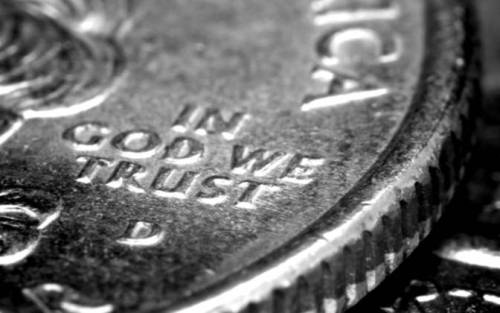 2017 - 1957 - First appearance of "In God We Trust" on U.S. paper currency. "In God We Trust" was first added to U.S. coins during the beginning of the Civil War, when religious sentiment was on an upswing and concerned Americans wanted the world to know what their country stood for. Many wrote to Secretary of the Treasury Salmon P. Chase on the matter, and he agreed with their arguments. Congress passed his act requesting the addition of "In God We Trust," adapted from a lesser-known verse of Francis Scott Key's "Star-Spangled Banner," and the first two-cent coin with the phrase was minted in 1864. The motto appeared on paper currency beginning in 1957, and in the subsequent decades, numerous legal actions have sought to remove it from currency and strike "under God" from the Pledge of Allegiance. TIME magazine suggested in a 1991 story, that the banality of the phrases may not be worth the fight as a symbol of separating church from state. "Today even ardent separationists seem to agree with retired Supreme Court Justice William Brennan, who wrote in 1983 that slogans such as 'In God We Trust' have 'lost any true religious significance.'" I might have believed this at one time. Now...not so much. | ||||
|
|8|O|8|O|8|O|8|O|8|O|8|O|8|O|8| Gay Wisdom for Daily Living from White Crane Institute "With the increasing commodification of gay news, views, and culture by powerful corporate interests, having a strong independent voice in our community is all the more important. White Crane is one of the last brave standouts in this bland new world... a triumph over the looming mediocrity of the mainstream Gay world." - Mark Thompson Exploring Gay Wisdom & Culture since 1989! |8|O|8|O|8|O|8|O|8|O|8|O|8|O|8| | ||||

|
|||||

|
