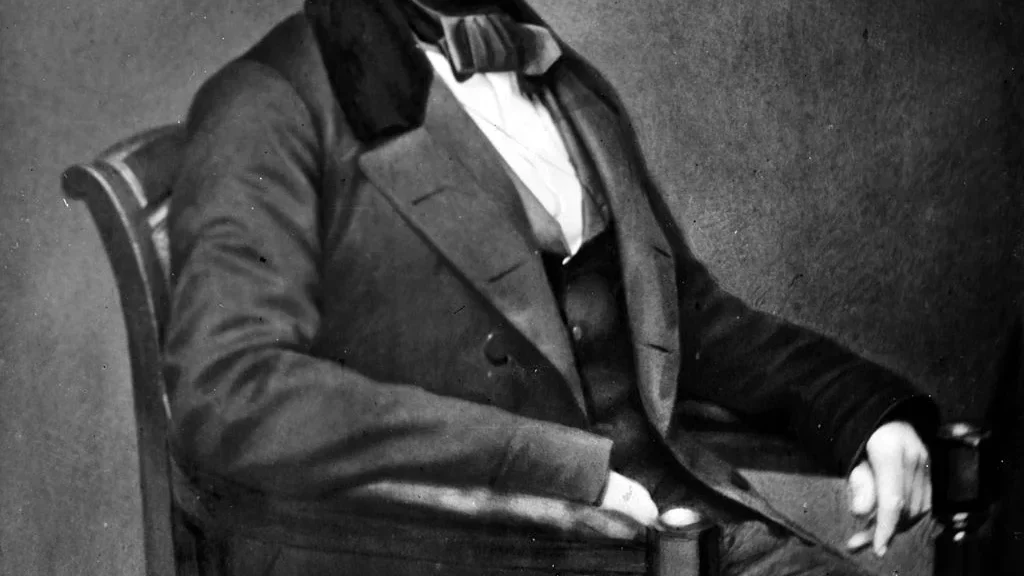
FITZ-GREENE HALLECK, who passed on this date, (b: 7/8/1790) was an American poet and member of the Knickerbocker Group.
Born and raised in Guilford, Connecticut, he went to New York City at the age of 20, and lived and worked there for nearly four decades. He was sometimes called “the American Byron”. His poetry was popular and widely read but later fell out of favor. It has been studied since the late twentieth century for its homosexual themes and insights into nineteenth-century society.
In 1832, Halleck, a cultural celebrity, started working as personal secretary and adviser to the philanthropist John Jacob Astor, who appointed him as one of the original trustees of the Astor Library. Given an annuity by Astor’s estate, in 1849 Halleck retired to Guilford, where he lived with his sister Marie Halleck for the remainder of his life.
Halleck began to write with his friend Joseph Rodman Drake. In 1819 they wrote and published the anonymous Croaker Papers, which were satires of New York society. These 35 poems were published individually in the New York Evening Post and National Advertiser over several months. An unauthorized collection was published in 1819 with 24 selections. They published the poems under the pseudonyms Croaker; Croaker, Jr.; and Croaker and Co., taken from a character in Oliver Goldsmith’s The Good‐Natured Man. The “Croakers” were perhaps the first popular literary satire of New York, and New York society was thrilled to be the subject of erudite derision.
That year, Halleck wrote his longest poem Fanny, a satire on the literature, fashions, and politics of the time. It was modeled on Lord Byron’s Beppo and Don Juan. Published anonymously in December 1819, Fanny proved so popular that soon the initial 50 cent-edition was fetching up to $10. Two years later, its continuing popularity inspired Halleck to append an additional 50 stanzas.
Both Halleck and Drake became associated with the New York writers known as the Knickerbocker Group, led by William Cullen Bryant, James Fenimore Cooper and Washington Irving, pioneers in their fields. Drake advised Halleck to pursue becoming a nationally known poet and to sit on “Appalachia’s brow.” He thought contemplating the immense power of American nature would inspire his friend’s imagination. A medical student, Drake died in 1820 of tuberculosis at age 25. Halleck commemorated his friend in “The Death of Joseph Rodman Drake” (1820), which begins, “Green be the turf above thee”.
Halleck never married. His biographer, John W. M. Hallock, believes that he was homosexual. He found that Halleck was enamored at the age of 19 with a young Cuban named Carlos Menie, to whom he dedicated a few of his early poems. Hallock suggests that Halleck was in love with his friend Drake. James Grant Wilson noted how the poet described serving as best man at Drake’s wedding:
“Drake has married, and, as his wife’s father is rich, I imagine he will write no more. He was poor, as poets, of course, always are, and offered himself a sacrifice at the shrine of Hymen to shun the ‘pains and penalties’ of poverty. I officiated as groomsman, though much against my will. His wife was good natured, and loves him to distraction. He is perhaps the handsomest man in New York, — a face like an angel, a form like Apollo; and I as well knew that his person was the true index of his mind, I felt myself during the ceremony as committing a crime in aiding and assisting such a sacrifice.”
Hallock described the poet Halleck’s last major work, “Young America”, as both a “jaded critique of marriage and a pederastic boy-worship reminiscent of classical homosexuality.”
In his will Halleck asked for Drake’s body to be exhumed and reburied with him. In 1903, plans were set to move the bodies of Drake, his wife, daughter, sister, and nephew to Halleck’s plot in Guilford, Connecticut.
Halleck had several years in which he did not produce any literary works. After his death, poet William Cullen Bryant addressed the New York Historical Society in February 1869, and spoke about this blank period in Halleck’s career. He ultimately concluded: “Whatever the reason that Halleck ceased so early to write, let us congratulate ourselves that he wrote at all.”
Since the later 20th century, Halleck’s poetry has been studied for its homosexual themes, and for what it reveals about the social world of the nineteenth century.