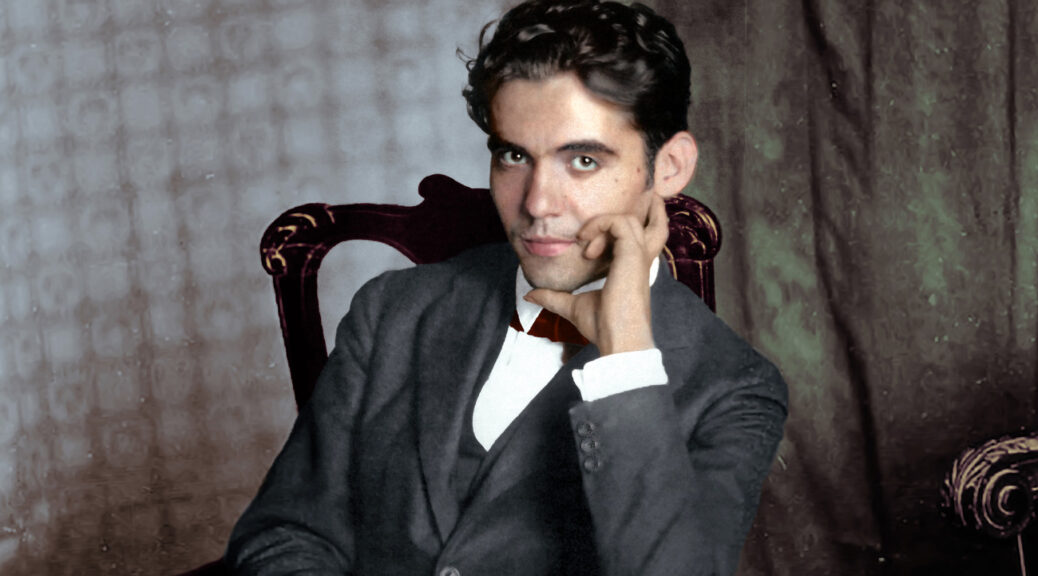
FEDERICO GARCÍA LORCA, Spanish poet, lyricist and dramatist (d. 1936); a Spanish poet and dramatist, also remembered as a painter, pianist, and composer. An emblematic member of the Generation of ‘27, he was killed by Nationalist partisans at the age of thirty-eight at the beginning of the Spanish Civil War. Born in Fuente Vaqueros, province of Granada, on June 5, 1898, Federico García Lorca is internationally recognized as Spain’s most prominent lyric poet and dramatist of the twentieth century. His poetry and plays have been translated into dozens of languages and have been the object of study by critics all over the world.
Since his murder in 1936 at the hands of Spanish fascist forces, Lorca has become a legendary tragic hero. One cannot help speculating about Lorca’s unfulfilled projects, the many more works he had planned to write and would have written had he not been the victim of a death that to this day is still clouded with controversy.
Equally controversial are the thinly veiled homoerotic motifs and themes present in Lorca’s work that have long been intentionally silenced and overlooked by those wishing not to “soil” the reputation of one of Spain’s most respected bards; among them, the Franco regime, the Lorca family, and homophobic Lorquian scholars who have dedicated their lives and careers to Lorca’s work yet refuse to acknowledge a line of criticism that takes into account homoerotic desire.
In 1919, Lorca went to study at the University of Madrid and lived at the Residencia de Estudiantes–a student residence founded in 1910 as a center of intellectual life for gifted students. Among the students at the “Resi,” as it was familiarly known, were Spain’s most talented young artists and writers. The surrealist painter Salvador Dalí, with whom Lorca fell deeply in love, and Luis Buñuel, later famous as a film maker, became close friends with Lorca, whose room soon became a popular meeting place for intellectuals around Madrid.
For a marvelous treatment of these relationships, see the film Little Ashes, directed by Paul Morrison. With Javier Beltrán, Robert Pattinson, Matthew McNulty. After what has been generally described as a “mysterious emotional crisis” (in fact, a depression brought on by Dalí’s sexual rejection as well as by a stormy relationship with a young sculptor, Emilio Aladrén Perojo), Lorca traveled to New York City in 1927. This trip inspired some of his most singular poetic pieces, later collected under the title Poet in New York (1940).
After leaving New York City, Lorca spent three months in Cuba, a place he had dreamed of visiting ever since he was a child and where he spent, according to his own account, the happiest days of his life. Following his stay in New York City and Cuba, Lorca began to be more daring in the representation of homosexuality.
Far away from his family and conservative Spanish values, he was able to conceive and begin writing his most openly homosexual work: “Ode to Walt Whitman,” the dramatic piece The Public, and the unfinished The Destruction of Sodom. “Ode to Walt Whitman,” published in Mexico in 1934 in a limited edition of fifty copies, but never published in Spain during Lorca’s lifetime, reveals the poet’s own contradictions concerning homosexuality. The ode takes on a moralistic tone by marking a clear distinction between a pure and de-sexualized homosexual love, epitomized by Whitman the lover of nature, and a debased sexuality, associated with the “maricas” or faggots (effeminate homosexuals).
The Public, which with the exception of two scenes published in a Spanish magazine during Lorca’s life was not published until 1978, and even then in an incomplete version, presents an examination of repressed homosexual desire as well as a defense of the individual’s right to erotic liberty.
Lorca categorized The Public, his most experimental play, as belonging to his “impossible theater.” Also belonging to the impossible theater is The Destruction of Sodom, of which Lorca apparently wrote one act, although today only the first page of the piece survives. The theme of this play, according to Ian Gibson, was to be “the pleasures of the homosexual confraternity, who have made such a contribution to world culture.”
Lorca had many lovers. Among them Rafael Rodríguez Rapún a player for Atlético de Madrid, actor and Spanish soldier of the Republican side; Aladrén Perojo, Emilio, a Spanish sculptor, whose parting sent the poet into a depression that caused him to leave to New York; and Philip Harry Cummings.
Cummings and Lorcamet in Madrid in 1928 and spent another brief time together when Lorca was en route to New York in June 1929. At the conclusion of the Columbia University summer session of 1929, Lorca went by train to Burlington, Vermont, and from there to the Cummings family’s summer rental cottage in Eden Mills, Vermont. During that visit, Cummings translated Lorca’s book Canciones (Songs) into English, with Lorca’s advice on key points. This is the only translation of Lorca’s work into any language in which he is known to have participated. During this period, Lorca also wrote several poems that became part of his book Poeta en Nueva York.[6]
Cummings and Lorca renewed their friendship in the fall of 1930 when Cummings returned to Madrid on a IIE fellowship. He returned to the United States abruptly the following spring on the advice of his IIE sponsors, just before Alfonso XIII left the throne. There is no evidence that Cummings ever saw Lorca again, although they may have continued to exchange letters. He did not return to Spain for many years; he was unhappy with Spain’s new, leftist government.
Cummings claimed to have destroyed an autobiographical manuscript that Lorca left with him in 1929, but there is no independent evidence that the manuscript ever existed, and Cummings is far from a reliable source.
It is thought that García Lorca was shot and killed by Nationalist militia on 19 August 1936. The author Ian Gibson in his book The Assassination of García Lorca argues that he was shot with three others (Joaquín Arcollas Cabezas, Francisco Galadí Melgar and Dióscoro Galindo González) at a place known as the Fuente Grande (‘Great Spring’) which is on the road between Viznar and Alfacar. Police reports released by radio station Cadena SER in April 2015, conclude that Lorca was executed by fascist forces. The Franco-era report, dated July 9, 1965, describes the writer as a “socialist” and “freemason belonging to the Alhambra lodge”, who engaged in “homosexual and abnormal practices”.
Significant controversy exists about the motives and details of García Lorca’s murder. Personal, non-political motives have been suggested. García Lorca’s biographer, Stainton, states that his killers made remarks about his sexual orientation, suggesting that it played a role in his death.