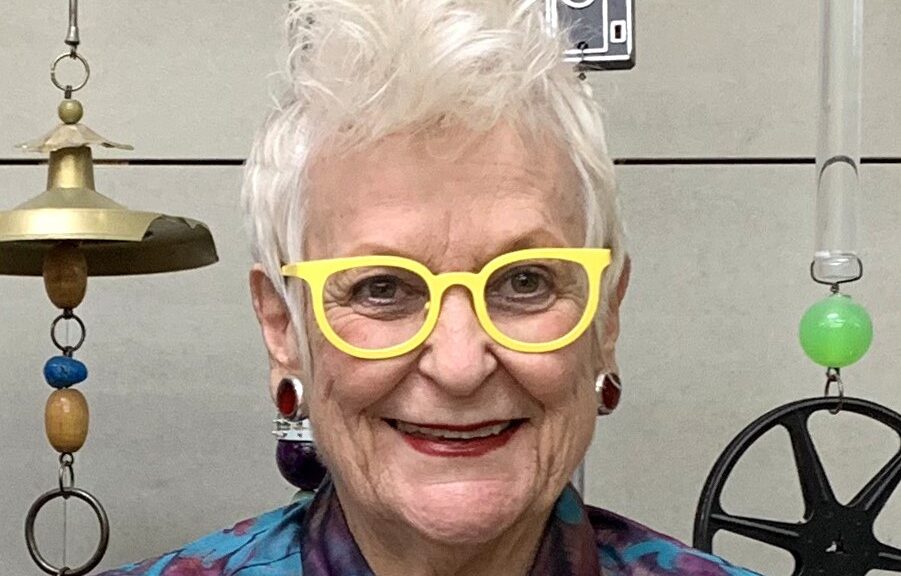
GAI GHERARDI, who was born on this date, was co-founder and designing creative director of l.a.Eyeworks — revolutionizing the eyewear industry and how it’s marketed, forging an influential design vernacular, and championing artists along the way.
Born in Glendale, CA, and raised an hour south in Huntington Beach. Gherardi was educated in the halls of that surf city’s eponymous high school, already conveying her maverick style in combat boots (to the prom, no less). This is where Gherardi met Barbara McReynolds. The pair bonded instantly over folk music and eyewear. Glasses were an obsession for both. So much so that a teen McReynolds with 20/20 vision faked an eye exam, and, after months of taxing her optometrist to find the perfect frames, scored a job in his office.
When the doctor opened a branch near UC Irvine in 1965, McReynolds hooked up Gherardi with employment there. When the friends opened the Melrose mothership in September 1979, Gherardi, in an interview, recalled that glasses “were still considered such a prosthesis. There was a lot of inhibition to wear them. But we were fearless about digging around to find great glasses.”
Gherardi and Barbara McReynolds transformed eyewear when the high school friends-turned-licensed opticians opened an optical boutique on Melrose Avenue in 1979. Within the year, the eyewear fanatics launched a signature frame despite neither being formally trained in design.
Brand and store, along with provocative slogans in the windows, soon became the heart of that storied street’s counter-cultural identity (punks, rockabillies, new wavers) thanks to an avid following of creatives and celebrities, and the founders’ deep support of artists. Their approach to merchandising shifted the way consumers perceived eyewear: as a sculpture to be viewed from all angles within a retail space that evoked a (friendly) art gallery. Among the distinguishing details: rounded temple tips inspired by Gherardi’s affinity for Australian green tree frogs. Eschewing visible logos on their designs, the frog-toe temple tip is an insider signal among architects to troubadours alike.
“A face is like a work of art. It deserves a great frame.” This now famous slogan defines the long-running black-and-white portrait ad campaign with photographer Greg Gorman. Pee-wee Herman (the late Paul Reubens), who trained a few doors away as a Groundling, featured in the first ad in 1982. Since, it’s been a roll call of iconoclasts: Grace Jones, John Waters, George Clinton, David Hockney, Rufus Wainright, Zandra Rhodes, Sir Ian McKellen, Jodie Foster, RuPaul and, most recently, Justin Vivian Bond. Elton John, who would send a tall Louis Vuitton trunk with individual drawers for all the frames he scooped up, also featured in the portrait series, now well past the 200 mark and counting. Grafiche Damiani published 171 of those images in a lavish book in 2011.
Gherardi was born in Glendale, CA, and raised an hour south in Huntington Beach. In the halls of that surf city’s eponymous high school and already conveying her maverick style in combat boots (to the prom, no less), Gherardi met McReynolds. The pair bonded instantly over folk music and eyewear. Glasses were an obsession for both. So much so that a teen McReynolds with 20/20 vision faked an eye exam, and, after months of taxing her optometrist to find the perfect frames, scored a job in his office. When the doctor opened a branch near UC Irvine in 1965, McReynolds hooked up Gherardi with employment there. When the friends opened the Melrose mothership on September 9, 1979, Gherardi, in an interview, recalled that glasses “were still considered such a prosthesis. There was a lot of inhibition to wear them. But we were fearless about digging around to find great glasses.”
Within months of opening, they submitted a sketch to a French eyewear maker: a classic acetate frame that nodded to those worn by lifeguards. They christened the unisex style “The Beat.” Hundreds of influential original frame designs in expressive colourways have followed, manufactured in Europe and Asia according to the highest standards in the marketplace. In 1984, Eyeworks 3 launched, with partner Margo Willits and an office in France, to distribute the line worldwide.
Their distinct signature frames have been exhibited at the London Design Museum, the London Craft Council, the Los Angeles Craft Museum, the London College of Fashion, and the Chicago Athenaeum, among others. The limited-edition “Face It” collection, l.a.Eyeworks frames custom-embellished by artists, designers, and jewelers, has toured worldwide. Passionate about glasses as objects, Gherardi and McReynolds amassed an extensive collection of vintage fantasy frames, which has also toured museums internationally. The brand’s credits in Hollywood and music are significant, including cult classics such as “Thelma and Louise” and “The Matrix.” But it’s the shopfront’s representation, albeit apocalyptic, in “Blade Runner” that continues to send fans emailing the company to this day.
Forays into expression and artist collaborations have proven limitless, from programming to architecture to merchandising. In contrast to Gorman’s high-contrast, timeless portraits, l.a.Eyeworks launched the Technicolor “Uncensored Visions” ad campaign in 2019. Shot by LA lensman Josef Jasso, it has featured electroclash star Peaches, drag star Murray Hill, thereminist Armen Ra, and LA punk icon Alice Bag.
From the first day, the store windows have featured thought-provoking, double-entendre messages and site-specific installations with commissioned artists, characterized by offbeat humour, agitprop, and the celebration of the absurd to comment on culture, gender, and politics. Among the most talked about, and in response to the government’s challenge with talking about condoms during the AIDS crisis, was the late Robert Warner’s assemblage of black frames inside condoms hanging by threads behind the window vinyl “Safe Spex.” More recently, fun puns include “Elect to Think,” the Supreme Court-inspired “Eye Object,” and the Pride-fuelled “Wear Them Out.”
“The genius of what Gherardi and McReynolds created with l.a.Eyeworks is its infinite flexibility and knack for zeroing in on timeless concepts,” notes Robert Rich, CEO of l.a.Eyeworks. “It’s a legacy we will proudly carry forward into the future.” That future nears as the company readies a new retail flagship in a campus-like setting on Fairfax Avenue in Hollywood. That complex is slated to open later this spring.
Gherardi devoted considerable resources and time to freedom of expression (summed up in the catchphrase “Uncensored Visions”), women’s rights (Planned Parenthood, among them) and AIDS-relief organizations (Project Angel Food). She was serving as board president of Art Matters, the NYC-based nonprofit which has gifted 2,000 grants to artists since 1985, at the time of her death. She also regularly served on national arts and design juries; and lectured internationally on design and brand development.
Gai Gherardi died March 16, 2025, following a brief illness due to cholangiocarcinoma. She was 78. She is survived by her life partner of 50 years Rhonda Saboff; sister Heather Gherardi; nephew Jett Schuster, grandnephew Mason Schuster, grandniece Stella Schuster; stepsisters Michelle and Rene Gherardi, and goddaughters Sula Fay and Pazia Luz Bermudez-Silverman.